I will be straight and to the point. I like the name Wii. I think it's refreshing, weird, and somehow fits in the universe that Nintendo has created for themselves. Wii, which is pronounced "we", is the new name for the new Nintendo console, once dubbed by the codename Revolution. The codename definitley explains what the system was all about with its new angle on gameplay. With the unveiling of the remote/controller hybrid, Nintendo is showing the world how to play games again.
But then came a rather shocking announcement from the big N. It has become custom for Nintendo to reveal some of their projects before E3( Nintendo DS, GBA SP), and so this year Nintendo dropped the bomb by announcing that their new console will henceforth be called Wii. This has got the whole gaming world off gaurd and has garnered mixed reactions. Most of which has been in the negeative. Here are some examples of what a couple of editors over at 1up.com said.
"What the holy hell are they smoking over there in Nintendoland? This is a classic cross-culture blunder; it may not be "bite the wax tadpole" but lord, it ain't good. Although, I do appreciate that it opens the door to some awesomely bad urine jokes."
- Joe Rybicki
"Actually, it's probably smart. It will never be a good name for a videogame console, but it's so unbelievably weird that it's bound to have people talking."
- Shane
Despite the reactions however, the vast majority seem to either dislike the name or abuse it for toilet jokes. I have been guilty of the later, but I seriously like Wii. Wii just seems to have enough weirdness to it that it just seems to fit. Anyway, the choice of the name Wii was rahter intersting. Game Informer held an interview with a NOA rep who said that the name "Wii" symbolized playing together and allowing people to interact with their games in a new way.
However, with a name like Wii for Ninendo's next big console, one must take a look back at the other consoles with usual names that didn't sit well with the public. For instance our good buddy the Dreamcast is a prime example. A console that had a good and unfortunately short run. Dreamcast seemed like a name that might be associated with those deamcatcher rings. While it is still an odd name for a console the Dreamcast has managed to not only become a staple in gaming history but years after its life, to be known as one of the best console names ever.
Of course this might also go to show that a console's name when first announced can in fact hurt sales of a console. Why buy a system as weird as a Dreamcast when you can buy the cool sounding system like a playstation 2. A poll over at Gamefaqs has shown that over 37,000 people won't buy the system or say that sales will hurt Nintendo because the name is just weird. That 37,000 that aren't getting a sysem because of a silly name. Its probably really silly of them to do that, but its their choice and in the end it's Nintendo who get's hurt.
Nintendo lately seems to be taking huge risks with what they have been doing. The DS was a big risk and in the end has become profitable. The name DS has also become a staple in the view of the public. Weither it meant Dual Screen or Developer System, it didn't matter since the name was well recieved by the public. Nintendo wanted to change the way people played games and the DS is proof that people will want new experiences when playing games. Eventually this might be the case with Wii once everyone is able to fully realize what the system is capable of. And for that we must wait until E3.
E3 is the ultimate test for Nintendo. Once they win people over with their games and virtual System service I gaurentee that you'll still hear the toilet jokes but the name will have a more positive impact on gaming. Revolution by description, Wii by name, a gaming expereince Wii will soon enjoy.

5.02.2006

4.25.2006
This Magic Market
This Magic Market
By Karl Castaneda
The video games industry is growing, and with that growth, there’s lots of money to be made. Unfortunately, the competition for those fat sacks of cash is fierce. It takes a lot more than a good concept to sell a title to gamers these days. Some prefer familiarity, others look for something original, and some of them go simply be word of mouth. To push their chances to the absolute maximum, though, publishers invest millions every year in advertising. Whether it’s a full-page spread on Electronic Gaming Monthly or a thirty-second TV spot, you can bet the most popular games of the year have big bucks backing their success. But there are so many ways to do it. Let’s explore a few…
Classic Style: Print Ads
Everyone’s familiar with print ads. We see them in newspapers, in magazines, and even on the street at bus stops. With gaming, it’s pretty straight-forward; some concept art or a fancy-looking render with a super-imposed logo and some PR-talk designed to get you hyped and ready to give up your hard-earned cash. However, it’s not always pretty when a publisher decides to deviate from the basic formula.
By Karl Castaneda
The video games industry is growing, and with that growth, there’s lots of money to be made. Unfortunately, the competition for those fat sacks of cash is fierce. It takes a lot more than a good concept to sell a title to gamers these days. Some prefer familiarity, others look for something original, and some of them go simply be word of mouth. To push their chances to the absolute maximum, though, publishers invest millions every year in advertising. Whether it’s a full-page spread on Electronic Gaming Monthly or a thirty-second TV spot, you can bet the most popular games of the year have big bucks backing their success. But there are so many ways to do it. Let’s explore a few…
Classic Style: Print Ads
Everyone’s familiar with print ads. We see them in newspapers, in magazines, and even on the street at bus stops. With gaming, it’s pretty straight-forward; some concept art or a fancy-looking render with a super-imposed logo and some PR-talk designed to get you hyped and ready to give up your hard-earned cash. However, it’s not always pretty when a publisher decides to deviate from the basic formula.
4.23.2006
Sin & Redemption 8
Sin & Redemption
Karl Castaneda
Ch-ch-ch-changes
When the N64 lauched in 1996, we all thought Nintendo had it in the bag. They had a stronger processor (courtesy of Silicon Graphics Inc.), a revolutionary control scheme, and Super Mario 64. When it released in America, there were only two games. The aforementioned Mario title, and Pilotwings 64, a sequel to a game that had accompanied the Super Famicom. Unfortunately for Nintendo and Hiroshi Yamauchi, they had overestimated themselves.
After Square had completed Super Mario RPG: Legend of the Seven Stars for the SNES (Fun Fact: The game brought together two masters in the art of game music for the only time ever: Nobuo Uematsu from the Final Fantasy camp and Legend of Zelda/Mario's Koji Kondo.), they had grabbed hold to Sony's wing. And with them went Enix's Dragon Quest, Capcom's Mega Man, Konami's Metal Gear, and a plethora of other valuable properties. The paradigm had shifted. Things had changed. Nintendo was, for the most part, alone.
Karl Castaneda
Ch-ch-ch-changes
When the N64 lauched in 1996, we all thought Nintendo had it in the bag. They had a stronger processor (courtesy of Silicon Graphics Inc.), a revolutionary control scheme, and Super Mario 64. When it released in America, there were only two games. The aforementioned Mario title, and Pilotwings 64, a sequel to a game that had accompanied the Super Famicom. Unfortunately for Nintendo and Hiroshi Yamauchi, they had overestimated themselves.
After Square had completed Super Mario RPG: Legend of the Seven Stars for the SNES (Fun Fact: The game brought together two masters in the art of game music for the only time ever: Nobuo Uematsu from the Final Fantasy camp and Legend of Zelda/Mario's Koji Kondo.), they had grabbed hold to Sony's wing. And with them went Enix's Dragon Quest, Capcom's Mega Man, Konami's Metal Gear, and a plethora of other valuable properties. The paradigm had shifted. Things had changed. Nintendo was, for the most part, alone.
4.21.2006
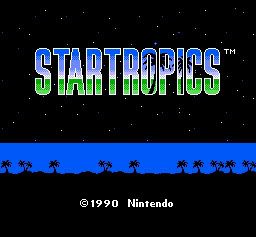
Lost Gems 4: Star Tropics
Alright kids, pack your stuff we are going to Coral Island for vacation. We are going to visit an old friend. The Star Tropics series. Easily one of the greatest and overlooked franchises on the NES platform. At times it was seen as a joke to the public mainly in part that the main character's weapon was a yoyo, but looks can be deceiving. And since this was a Nintendo title you are going to get more than just a decent game here.
4.18.2006
What About Hubbs.
Well I think I need to let you people know straight up that I am kind of tanking. My engines aren't running properly and I can't get them started. Fear not though as apparently this is kind of a seasonal thing I believe. About this time last year I was haivng difficulty finding the urge to write and this went on for about 2 to 3 months. I was still able to write but not as often as I usually do.
I was going to do a new Lost Gems on the Sega CD game Vay, but then I thought it would be neat if I could try and get a small interview with Victor Ireland of former Working Designs fame. I wanted to do something unique like how the project went with the game and such. However Victor is rather elusive at the moment so that project is on hold. SO instead I am going to work on the Star Tropics series as my next Lost Gems.
Cross your fingers and hope I don't competely burn out on you folks. I have a quota to meet and I am pretty sure Karl is tired of providing a vast majority of the material for this site.
Cheers.
I was going to do a new Lost Gems on the Sega CD game Vay, but then I thought it would be neat if I could try and get a small interview with Victor Ireland of former Working Designs fame. I wanted to do something unique like how the project went with the game and such. However Victor is rather elusive at the moment so that project is on hold. SO instead I am going to work on the Star Tropics series as my next Lost Gems.
Cross your fingers and hope I don't competely burn out on you folks. I have a quota to meet and I am pretty sure Karl is tired of providing a vast majority of the material for this site.
Cheers.
4.13.2006
Sin & Redemption 7
Sin & Redemption
By: Karl Castaneda
Ken
When we last left Nintendo back in Sin & Redemption 6, they were on the road to disappointment with the N64, and while they would put out many memorable titles on the console, it wouldn't be able to uphold the legacy created by the Famicom and Super Famicom. Indeed, it was a crushing blow to the company, and especially so to Hiroshi Yamauchi, who had put so much stock in the system as yet another success in his tenure as President and CEO of Nintendo Co. Ltd. But that's not what Sin & Redemption 7 is about. Let's do it differently, this time; how about we explore the man who would blow a new wind into the industry, not only in Japan, but the entire world. Let's talk about Ken Kutaragi.
Visions of Grandeur
By: Karl Castaneda
Ken
When we last left Nintendo back in Sin & Redemption 6, they were on the road to disappointment with the N64, and while they would put out many memorable titles on the console, it wouldn't be able to uphold the legacy created by the Famicom and Super Famicom. Indeed, it was a crushing blow to the company, and especially so to Hiroshi Yamauchi, who had put so much stock in the system as yet another success in his tenure as President and CEO of Nintendo Co. Ltd. But that's not what Sin & Redemption 7 is about. Let's do it differently, this time; how about we explore the man who would blow a new wind into the industry, not only in Japan, but the entire world. Let's talk about Ken Kutaragi.
Visions of Grandeur
4.11.2006
In Search of Player 1
The quote you see before you was taken earlier this year, a month or so before the Game Developers Conference, where Koster would make a keynote speech about the importance of "fun" in gaming. Now, as I outlined in a previous editorial, this is a great thing; it's entirely necessary to pursue entertainment rather than the ego-driven pretentious trash we see so often. However, and I'm sure this is what you took notice of first, the blunt wording of his comment is not only wrong in a factual sense (I had no idea video games had only been around for 21 years!), the very implication that single-player games are a pox on our industry is ludicrous. But what of "...and is about to go away...?" Well, as much as we disagree of a variety of things, Mr. Koster might have a point.
4.09.2006
Gaming Vision: What's Up Next
Well, I know there hasn't been anything new in about a week, but that doesn't mean we're out of ideas, far from it. After my little vacation in Ocala (read: that city sucks) I'm ready to get back to work. Check out what's coming up soon on the digital pages of Gaming Vision:
A new season of Sin & Redemption
New interviews!
A new editorial coming this week
13% more Hubbs
And that's just the beginning. Don't fret; new stuff's coming.
And that's just the beginning. Don't fret; new stuff's coming.
4.02.2006
The High Definition Era of Gaming
The idea of HD gaming may have started as far back as the Dreamcast. The Dreamcast was the first system to support vga, s-video, and rgb inputs. It was also capable of outputing games at a resolution of 640x480 on a pc monitor. Microsoft a few years later said that the Xbox wil support HD with a minimum support of all games at 480p. For the 360, Microsoft made the decision that they would push HD gaming into the mainstream. So now I dare ask the ultimate question of life.
Are we there yet?
High Def gaming. Is it really the future of where the next gen of gaming needs to go? Are we at the point where we all need High Def to further improve our gaming experience? Well to be brutally honest I believe we aren't quite there yet. Right now I am pretty sure all you High Def buffs are all up in arms now about I don't really see the point in pushing high def gaming yet.
High Def gaming. Is it really the future of where the next gen of gaming needs to go? Are we at the point where we all need High Def to further improve our gaming experience? Well to be brutally honest I believe we aren't quite there yet. Right now I am pretty sure all you High Def buffs are all up in arms now about I don't really see the point in pushing high def gaming yet.
4.01.2006
Innovative Tendencies
Innovative Tendencies
By: Kart Castaneda
The latest buzzword in the industry today seems to be "innovation." Every press release, every keynote address, and every preview seems to include it least once in its content. The race to be "new" and "fresh" has been iterated over and over again, and for a while, I was completely in favor of it. The fact of the matter is that innovation is only effective when it's thought out clearly, and when it isn't, the term becomes rather weightless.
In an American Scholar essay, the author made the point that with an added emphasis on creativity, where everyone and everything was supposed to be "original" and "different," the word eventually lost its potency, and fell to frivolous use. In the games industry, the same process is happening to "innovation." To put it simply, too much is being put into our games.
By: Kart Castaneda
The latest buzzword in the industry today seems to be "innovation." Every press release, every keynote address, and every preview seems to include it least once in its content. The race to be "new" and "fresh" has been iterated over and over again, and for a while, I was completely in favor of it. The fact of the matter is that innovation is only effective when it's thought out clearly, and when it isn't, the term becomes rather weightless.
In an American Scholar essay, the author made the point that with an added emphasis on creativity, where everyone and everything was supposed to be "original" and "different," the word eventually lost its potency, and fell to frivolous use. In the games industry, the same process is happening to "innovation." To put it simply, too much is being put into our games.
Subscribe to:
Posts (Atom)